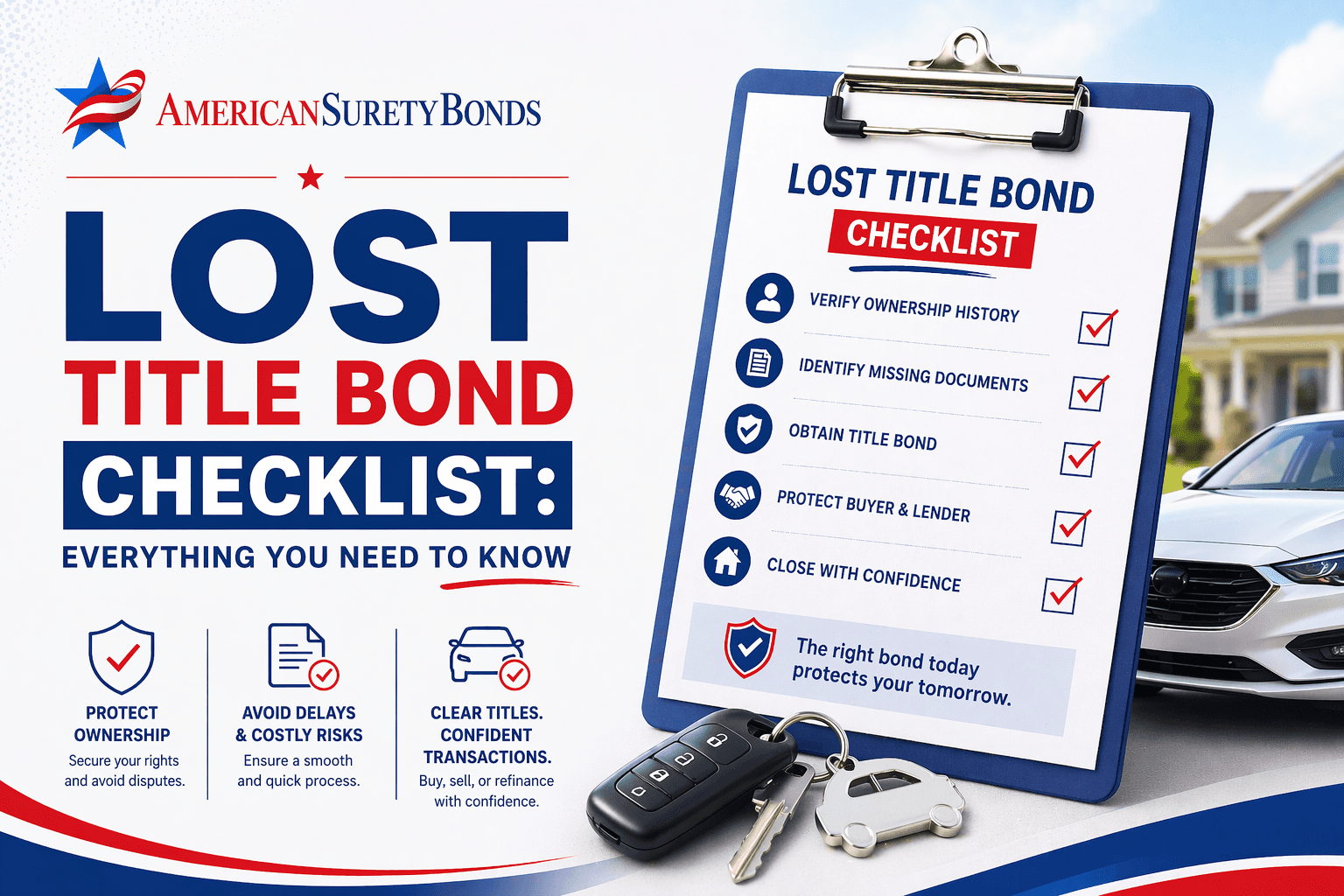
hase 1: Before You Apply for the Bond
The steps you take before the bond application determine how smooth the DMV process will be. Most rejections and delays happen because applicants skip steps in this phase.
Confirm a bonded title is the right solution for your situation. If you already have a title in your name and simply lost the physical document, you need a duplicate title from the DMV — not a bonded title bond. A bonded title is for situations where no clean title exists or the chain of title is broken. Confirm with the DMV before proceeding.
Gather all available documentation on the vehicle. Even if you don't have a title, collect everything: bill of sale, any prior title you have even if not in your name, MSO if available, prior registration documents, any receipts or records from previous owners. More documentation = smoother DMV review.
Run a VIN history check. Use NMVTIS (National Motor Vehicle Title Information System) or a commercial service like Carfax or AutoCheck. This surfaces any active liens, prior theft reports, or out-of-state title records you may not know about. Discovering a lien or a title in another state now is far better than discovering it after you've applied.
Check for any outstanding liens through your state DMV. Some states allow you to search lien records by VIN before applying for a bonded title. If an active lien exists, you may need to contact the lienholder directly before proceeding — the bond cannot eliminate an active lien, only cover the risk of one resurfacing.
Determine the vehicle's current market value. Use NADA Guides (nadaguides.com) or Kelley Blue Book (kbb.com) to get the current retail value for your year, make, model, mileage, and condition. Print or save the valuation — you will need it for the bond application and potentially for the DMV application as well.
Confirm your state requires a surety bond for bonded title (vs. a DMV-only process). All 17 states we cover require a surety bond from an admitted carrier. Some other states handle bonded titles through an internal DMV process without a third-party bond — confirm your state's process before applying.
Download your state's DMV bonded title application form. Get the correct current form from your state DMV website before you apply for the bond. The bond certificate must be formatted to match the state's requirements — having the form in hand before applying for the bond helps ensure everything is consistent.
Phase 2: Applying for and Receiving the Bond
Calculate the bond amount. In most states: Vehicle Market Value × 1.5 = Bond Amount. For a $14,000 vehicle, the bond amount is $21,000. This is the number you provide to the surety agency — not the premium you'll pay.
Apply for the bond from a licensed surety agency. Provide: vehicle year/make/model, VIN, state, and bond amount. Confirm the surety is licensed (admitted) in your state. An out-of-state or non-admitted surety's bond will be rejected by the DMV.
Verify the bond is on the state's required form. Most states have their own prescribed bond form. A generic bond form, even from a legitimate surety, may not be accepted. Confirm with your surety agency that the bond is issued on the state-specific form.
Review the bond certificate when received. Before submitting to the DMV, verify: correct VIN (match it character by character), correct vehicle description, correct bond amount, correct state as obligee, correct principal name (must match your legal name as it will appear on the title application).
Do not laminate, fold, or alter the bond certificate. The DMV receives the original. Any alteration, damage, or modification can result in rejection. Keep it flat and clean.
Make a copy before submitting. Keep a photocopy of the bond certificate for your records. You will need it for insurance purposes and as documentation if any claim or issue arises during the bond term.
Phase 3: State-by-State DMV Submission Checklist
The following items are needed for every bonded title application in our 17-state coverage area. State-specific additional requirements are noted.
Original surety bond certificate (not a copy — most states require the original)
Completed title application form (state-specific — see table below)
Bill of sale or proof of ownership (how you acquired the vehicle)
Government-issued photo ID matching the name on the title application
Vehicle identification number (VIN) verification — some states require a physical inspection or VIN verification by a law enforcement officer or licensed dealer
Vehicle valuation printout (NADA or KBB retail) — most states require this
DMV fee payment (varies by state; typically $15–$75 for a bonded title application)
Prior title documentation if available — even an incomplete or out-of-state title strengthens the application
Phase 4: After Submission — Tracking Your Clean Title
□ Confirm receipt of your DMV application. If submitting by mail, use certified mail with return receipt. If in person, get a receipt or confirmation number. Do not assume it was received.
□ Keep your surety's contact information and policy number accessible. If a claim is filed against your bond, you will be contacted. You need to be able to respond quickly with your surety's information.
□ If your state has a ~3-year term: note the bond expiration date. Set a calendar reminder 90 days before the bond term ends. If the DMV has not yet issued a clean title, you may need to renew the bond or contact the DMV about the title's status.
□ If your bond is annual (Connecticut only): renew before December 31. The CT bond renews January 1 every year. You will receive a renewal notice from your surety. Do not let it lapse — a lapsed bond can affect your DMV standing even if the original title was issued in good faith.
□ If your bond is "until clean title issued" (IL, IA DNR, CA): check in with the DMV at 12 and 24 months. These bonds don't have a fixed expiration — they run until the DMV issues a clean title. Proactively checking the status of your title application prevents the bond from running indefinitely without resolution.
□ When the clean title arrives: review it carefully before assuming it's clear. Confirm the bonded notation has been removed, the VIN matches, and the title is in your name as intended. If anything is incorrect, contact the DMV immediately — corrections are easier to make before you attempt a subsequent sale or transfer.
□ Notify your surety that the clean title has been issued. The bond's purpose has been fulfilled. While the bond will eventually expire regardless, notifying your surety closes the file cleanly and ensures there are no outstanding documentation gaps if you ever need to demonstrate clean title history.

Apply for Your Bond Today
Fast approvals, instant issue, and exceptional rates across all 50 states.